
Bangalore
Programme
Break
Lunch
Break
Break
Naan Oru Pen
Performance by Sowmiya. Naan Oru Pen is based on Maya Angelou’s Phenomenal Woman and Still I Rise. Directed by A Mangai.
Dinner
Welcome and Introduction to the Conference
Welcome address by Radha Ramaswamy.
Culture, Memory and Resistance: Dissent and Art in our Times
Nisha Abdulla in conversation with Arvind Narrain.
Break
Radical Play: Working with Children and Young People
Panel discussion, moderated by Timira Gupta. This panel discussion brings together representatives from AAGAAZ Theatre Trust (Delhi), WeLive Foundation (Bangalore), AASHIYANA (Mumbai), and individual art facilitators to explore the transformative power of Theatre of the Oppressed (TO) and other art modalities with children and young people from various distinct contexts. The panel will focus on how TO’s participatory techniques are used to empower, ignite and bring about action.
Lunch
Performing Gender
Session begins with Vellai Mozhi. A. Revathi enacts her life as a Tamil trans woman, stringing stories about finding community, navigating family relationships, encountering violence, building solidarities, finding and losing love, and discovering the joys of writing and performing.
Panel discussion follows, moderated by Ayush Gupta (Ayesha). Gender is one aspect by which society has been organised, especially around the idea that there are men and women, and there is a “real difference” between the two. Even as we feel the pressure to constantly align with man or woman in how we present, what we do, and how we live, we can also notice that fractures to this alignment exist in almost all lives. Our individual expression of gender is shaped, in part, by this push and pull of alignment and fractures. That is the performance of gender. Theatre also is shaped by these pushes and pulls, spotlighting alignments sometimes with the dominant performances of gender in life and sometimes subverting, challenging, and upturning the dominant performances. In this session, we will explore these aspects of how we wear our gender in theatre on stage and in the theatre of life.
Break
Performing Gender
Panel discussion continues.
Break
wepushthesky
Performance by Nisha Abdulla. wepushthesky is an interactive solo performance that weaves together food, song, story, myth, and history. Where personal stories meet community histories, survival stories of the Karbala entwine with songs of the Mappila Ramayana, and anecdotes from the past confront desires about the future.
Dinner
The Practice of Healing: The Arts & Humanities in Medical Education
Panel discussion, moderated by Dr Navjeevan Singh. “The three “experts” in this panel: Aqsa, Harshu, and Satendra have dared to forge their own paths in the face of persistent adversity that many thought insurmountable. If lived experience is given its due, besides their careers as physicians, these people have crammed several lives into the same time in which many of the rest of us struggle to live just one. They have broken many molds, inspired entire communities, and launched countless others’ lives into trajectories that have changed them for the better. They are activists in the true sense. I have often wondered what resulted in their awakening, the tipping points that triggered them to tread the paths they took, the actions they took and those they could not, the support they might have received and, importantly, the barriers they faced. I hope that they will share their stories of hope, of desire, of laughter, and of tears and show us the way forward.”
Break
The Practice of Healing: TO & Allied Arts for Mental Health
Panel discussion, moderated by Dr Nithya Poornima. Mental health is increasingly being recognized as an area that requires attention, engagement and action in various spheres of life, locally and globally. This panel will hear four accounts of how Theatre of the Oppressed and allied arts methods are being used in mental health contexts and in the provision of mental health care. The discussion intends to create an interactive space that offers a glimpse of the possibilities, discoveries, insights and challenges that have emerged when mental health care and TO meet and mingle!
Lunch
Jokering Change: Finding newer ways of walking together
Panel discussion, moderated by Benson Issac. We live in increasingly uncertain times with the threat of climate change, social, economic and political collapse. What does working for social change mean in these times? The practice of TO is centered around breaking the hegemony of single, clever, quick fix strategies. It builds on navigating our fragile egos to find democratic and complex solutions to complex problems. TO enables to be intersectional, collaborative and walk uncertain paths. How do we work with this invitation? How do we remain seekers and explorers on this path and how do we find more pathfinders to join us in this? Panelists are invited to speak, engage through TO techniques and respond in embodied ways that enable us to work with the complexity of Jokering Change.
Break
Jokering Change: Finding newer ways of walking together
Discussion continues.
Jokering Change: Finding newer ways of walking together
Closing discussion and feedback.
Break
Gorukana Dance
Performance by Soliga Pusumale Kala Tanda, led by Basavaraju Soliga. Gorukana is a rendering, into song, of their everyday experience in the forests, rich with references to birds, insects, trees and various other wildlife. Often capturing curious natural history and observations in its lyrics, the song brings people together into rhythm and dance around the evening fire, at festivals and other days alike.
Dinner
About
Welcome to Diversity Dialogues: Theatre of the Oppressed for our times!
This conference is for everyone who is looking for a methodology to start working with communities, or looking to deepen and strengthen their work with communities, or just wanting to be a part of initiatives for social change.
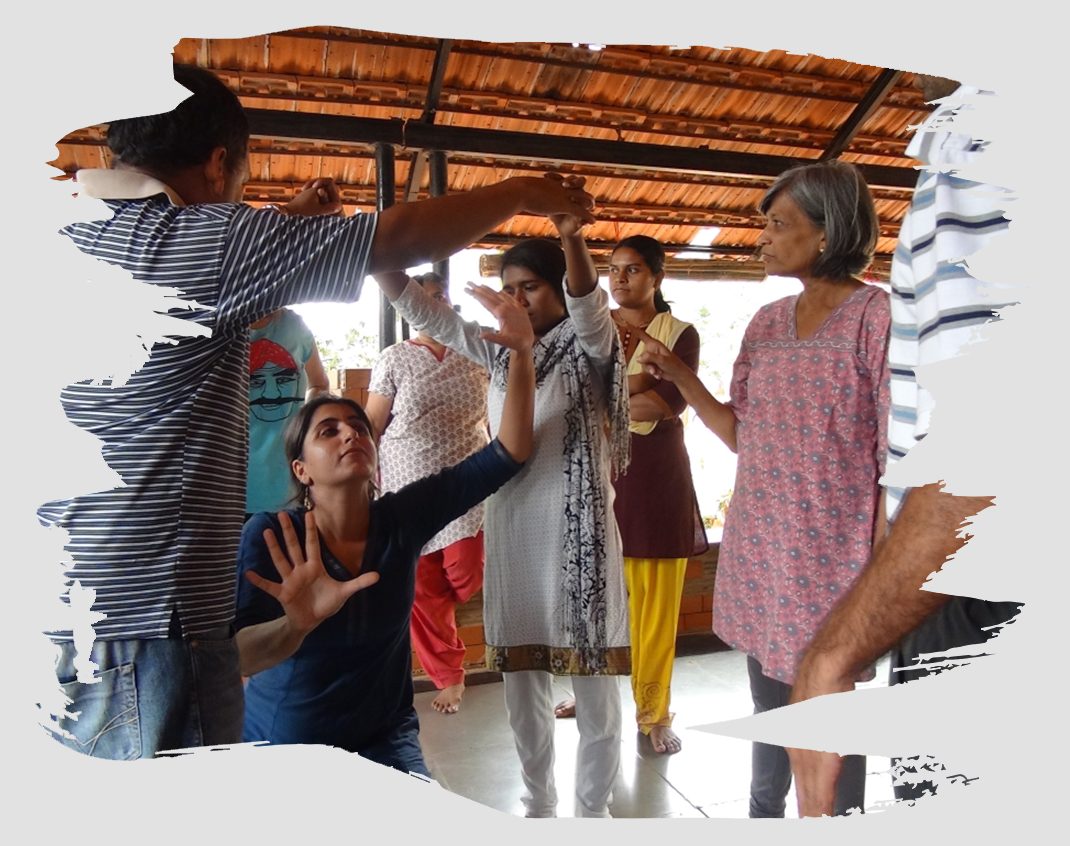
Can Theatre of the Oppressed (TO) - a methodology created in Brazil 50 years ago, and in response to a specific political situation - work for us here and now, in India? This is the question that we asked ourselves, a group of 20 TO practitioners, or Jokers as we are called in TO language, when we gathered in Bangalore in February 2023 - is TO relevant today?
The answer is YES! More than ever before, in fact. We are surrounded today by divisive and dehumanizing discourses. We are being pressured in an intentional, calculated manner, to stay in silos, compartmentalize our lives, our thoughts, and our work, so that our voices stay weak. More than ever, today we need the rehumanising power of TO. More than ever, today we need TO to bring us together in solidarity, and appeal to the joy and hope in us, instead of the fears and doubts.
This Conference shows how TO, along with other arts practices, can help us build communities of care.
A rather ambitious 3 part conference was conceptualized at the February 2023 Joker meet. We discussed some projects that were close to our hearts. We resolved to work on these projects and gather again when we had some findings to share. Between then and now, we met several times online to share our progress and our learnings, offering feedback, suggesting changes - in short, being a community of support. The Jokers leading these projects, CCDC alumni all, have come together for the concluding part of this 3-part Conference. We will share our insights, and also questions that remain, because the projects are works in progress. And therefore, we are excited and honoured to have with us, in this Conference, artists, activists and educators from whom we have much to learn. They too, like us, dream of a better India, an India where individuals and communities can live and work without fear of oppression and injustice.
This Conference is for all those who believe that change is possible. We will share our stories, our struggles and our hope. We will rehearse the idea of change in its many hues and forms; we will rehearse also the ways in which we can support each other in our resistance to the forces dehumanizing us.
We make the road by walking, said the Spanish poet Antonio Machado.
Together let’s figure out this new path.
Venue
Indian Social Institute
Address: 24, Benson Rd, Byadarahalli, Benson Town, Bengaluru, Karnataka 560046
Support this Conference!
The presenters you will meet at this Conference are all working to create a more equitable and just society. This Conference will help their work have a wider social impact. They will also pick up new tools, share ideas, and create networks of support .
This Conference will also be critical to the advancement of Theatre of the Oppressed in India. The connections made at the conference will help to sustain a vibrant TO community in India, ensuring that the practice continues to evolve and adapt to changing social realities.
Thank you for your support! You can donate by scanning the QR Code below.
UPI Code: dialogue21148@iob
QR Code:

Bank Transfer Details:
Account Name: Centre for Community Dialogue and Change
Account no. 066501000021148
Bank: Indian Overseas Bank
Branch: Sivan Chetty Garden
Account type: Savings
IFSC : IOBA0000665
If you experience any difficulty making your contribution, please contact us at contact@ccdc.in.